

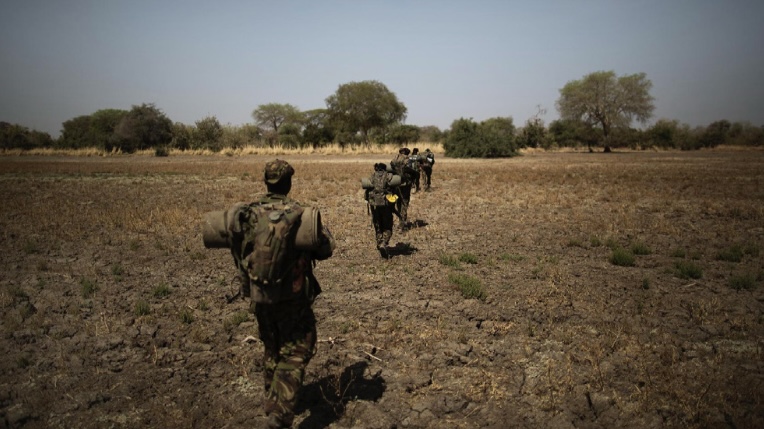
African Parks runs conservation sites all over the continent. Former staff describe the organisation’s operations as a ‘shitshow’ of toxic mismanagement and lawlessness.
was bewildered when he arrived
at the staff base in Zakouma National
Park earlier this year. His residence was
a camp where Chadian workers slept
outside on the ground and relieved
themselves in the bushes because there
were not enough toilets. He slept in a
tent in which temperatures rose to 40°C or 50°C. Chad’s best-preserved nature
reserve didn’t resemble one of the
“stunning conservation success stories
in Africa”, as The New York Times had
once described it.
As he settled into the role, David’s
dismay grew. He says the vehicle fleet
and equipment were poorly maintained
or outdated. Rangers’ motorcycles and
equipment for monitoring critically endangered black rhinos were often broken or malfunctioning.
Zakouma National Park is managed
by African Parks, a South Africa-based
NGO that runs 23 conservation reserves
in 13 African countries. The organisation
dismissed these complaints, saying
the “facilities in Zakouma exceed
comparable standards across Africa”. It
also said breakdowns in its vehicle fleet
were not “beyond the norm” and that it
reviewed the functionality of wildlife-
monitoring equipment every month.
In contrast, Chad’s government,
which has a long-term conservation
management contract with the
NGO, did not think African Parks was
running a tight ship. On 6 October, it
expelled the organisation for alleged
mismanagement and fraud.
But the N’Djamena government
did not account for African Parks’s
international allies. Its board includes
former Ethiopian prime minister
Hailemariam Desalegn and Britain’s
Prince Harry. A week after the expulsion,
the European Union ambassador
to Chad threatened to withdraw
$23-million in conservation aid to the
country. The EU provided more than
a third of the $67-million that African
Parks says it has spent on Zakouma
since 2010. The government made a
U-turn and renewed the African Parks
partnership on 17 October “in a spirit of
dialogue and co-operation”.
Smoking guns
Interviews with six former African
Parks staff – five of them managers –confirm Chad had reason for concern.
A former manager described African
Parks’s management of Zakouma as
“a shitshow”. All of them requested
anonymity, fearing retaliation. Some
filed formal complaints to African Parks
headquarters in May and June, before
they were fired or did not have their
contracts renewed.
The internal complaints, reviewed for
this investigation, describe extensive
management failures and a hostile
work environment in Zakouma. “Since
I’ve been working here, it’s pretty much
always been a mess. But the past nine
months have been nothing short of
dramatic,” said former manager Robin.
The most serious allegations are related to poaching incidents, which began last November. By March, 12 giraffes, at least 12 buffalo and two black rhinos had been killed. Local authorities arrested two wildlife trackers employed by African Parks and held them in prison for two weeks. Their photo, captioned “alleged poachers”, remains online.
The former employees say African Parks set the trackers up for failure.
“They couldn’t communicate because both their walkie-talkies and the satellite connection were faulty. The management knew about this but did nothing,” says former manager Franck.
African Parks did not hire a lawyer to
represent its detained employees.
The NGO dismissed Zakouma’s head
of conservation, a biologist, after the
poaching incidents. But the decision
left some of its workers perplexed. “He
served as a scapegoat,” says Robin, who argues that when management failures
lead to poaching, the park director
and the head of law enforcement bear
ultimate responsibility.
The park’s director, Frenchman
Cyril Pélissier, appears to have
been particularly divisive. “The
unpredictable director considered the
park his kingdom, with the head of
law enforcement below him, faithfully
carrying out his orders,” says Louis*,
another former manager.
Internal complaints even blamed
Pélissier for the second major tragedy
in Zakouma in the past 12 months: a
plane crash that killed a South African
pilot and a Chadian conservationist.
Staffers said Pélissier regularly
pressured pilots to fly, even in poor
health and bad weather. In one of the
internal complaints, a whistleblower
reported witnessing the director say, “it
will be your fault if a rhino is poached”, to dismiss a pilot’s hesitancy.
Another allegation is that ivory went
missing from African Parks’ warehouse
in Zakouma. Two former insiders said
an inventory conducted by six people
on 11 June found 15 tusks were missing.
They provided messages from one of the
auditors to back up this claim. But none
of the auditors was from the Chadian
government as should be the case.
African Parks maintains that “there is
no discrepancy in our ivory records in
Zakouma National Park.”
Zakouma just the latest flashpoint
“I see African Parks as a state within a
state. You’re on some kind of an island
with a military structure,” said Louis.
This assessment echoes wider criticism
that African Parks manages nature
reserves using a “fortress conservation”
model. Critics say it uses force to keep
nearby communities out of the nature reserves it manages, even when they
have historical claims to some of the
gazetted land.
The NGO vigorously dismissed this
characterisation in a statement, saying
“64% of the areas it manages have people
living in them and 90% of them allow
some access to resources within, in line
with local laws”. The NGO also said only
four of 23 parks it managed were fully
fenced and this was purely to prevent
human-wildlife conflict.
In May, however, African Parks
admitted that some of its staff committed
violations against the Baka people who
live near Odzala-Kokoua National Park
in the Republic of the Congo, which it
has managed for 15 years. This came
after British human rights lawyers –
hired by African Parks in reaction to
a report by Survival International –
investigated 21 separate incidents of
alleged abuse. These included physical
and sexual abuses such as rape, torture,
unlawful killing, and arbitrary arrests
and detention. African Parks didn’t
disclose which of the allegations had
been proven or how many people they
affected. The full report was submitted
to its board and remains confidential.
Across Africa, the NGO manages
more than 20-million hectares of land.
In the Democratic Republic of the
Congo, Zambia, and Malawi, many
sources, including victims and alleged
perpetrators, say human rights abuses
have happened within areas managed
by African Parks.
“In the park, there’s no room for
human rights,” said a former African
Parks ranger from the DRC.